
Exploripo Guide
When Should Writers Use Outlining? A Practical Decision Guide
Choose between a full outline, a light structural map, discovery drafting, or a reverse outline by matching the method to the uncertainty in your manuscript.
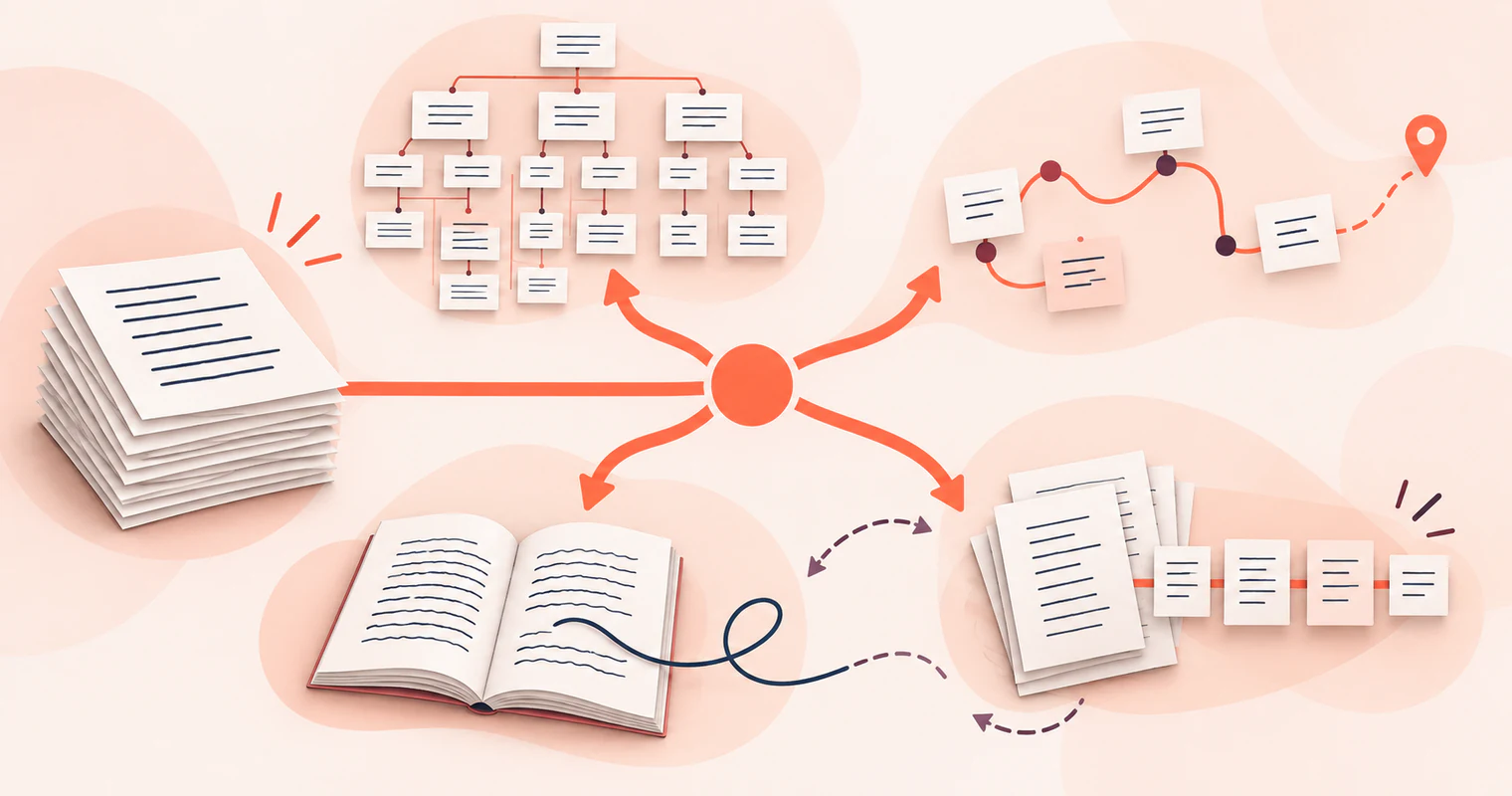
Outlining is not a test of whether you are a serious writer. It is one way to expose structural decisions before, during, or after drafting. A novelist with several timelines may need a detailed plan before chapter one; another writer may need ten exploratory pages before the real story becomes visible.
The useful question is not “plotter or pantser?” It is: what uncertainty is stopping this manuscript from moving forward, and what is the smallest planning method that can resolve it?
Quick Answer: Outline When It Reduces Uncertainty, Not Because You “Should”
Use more structure when unresolved dependencies are causing contradictions, hiding missing setup, or making the next scene impossible to choose. This often happens in multi-POV stories, mysteries, nonlinear narratives, or books with tightly connected reveals.
Use less structure when discovery is part of the creative work. If you are still finding the protagonist’s voice, testing the premise in scenes, or learning what the central conflict actually is, a detailed outline can give uncertain ideas a false appearance of certainty.
The decision can change. Start with a full outline, a light map, a discovery draft, or no forward plan beyond the next scene. Then switch when the manuscript gives you better information. None of these methods guarantees continuity, quality, completion, fewer revisions, or sales.
Four Ways to Plan a Draft
These four approaches are points on a spectrum, not competing identities:
- Full outline before drafting: Map chapters or scenes, major turns, dependencies, character arcs, and known reveals before writing continuous prose.
- Light structural map: Record the premise, destination, major beats, and a few constraints while leaving most scene-level choices open.
- Discovery draft: Begin with minimal structure and use scenes to discover voice, character, conflict, or the story’s real direction.
- Reverse outline: After prose exists, summarize what each scene or chapter actually does and inspect the manuscript’s current structure.
A project may use all four. A writer can discovery-draft the opening, turn the useful material into a light map, expand a complicated middle into a fuller outline, and reverse-outline the completed draft before revision.
Use a Full Outline When the Story Has Many Dependencies
A full outline is most useful when later events depend on precise earlier setup. Consider it when you need to synchronize several viewpoints or timelines, place clues before a reveal, track cause and effect across a long sequence, or maintain rules that many scenes must respect.
For a mystery, the outline might show the real clue, a plausible red herring, and what the viewpoint character knows at each stage. For a dual-timeline novel, it might track what each era contributes before the threads meet. The purpose is to make dependencies visible, not predict every line of dialogue.
Complexity alone does not make a full outline mandatory. If detailed planning freezes the characters before you understand them, outline only the fragile chain—such as the reveal sequence—and leave other scenes open.
Use a Light Structural Map When You Know the Direction but Not Every Scene
A light map suits a writer who knows the broad journey but wants room to discover how it unfolds. Record the opening situation, major turning points, likely ending or target state, and any non-negotiable setup. A sentence or two per beat may be enough.
This middle option gives the draft guardrails without prewriting every chapter. It works well for a mostly linear story, a character-led novel with a clear external goal, or an early manuscript whose ending is visible but whose middle remains flexible.
Keep unknowns visible instead of filling gaps merely to make the plan look complete. “Mara chooses whether to reveal the signal” is an honest decision point; speculative intermediate scenes may create maintenance rather than clarity.
Use Discovery Drafting When Exploration Is Part of the Process
Discovery drafting is rational when prose is how you learn what the story is. It can help you test a narrative voice, discover relationships through dialogue, explore whether a premise sustains scenes, or find which character should carry the book.
Give the experiment a boundary: draft the opening encounter, one scene from each possible viewpoint, or the central conflict. Then ask what became true on the page and what should guide the next phase.
Minimal planning does not mean ignoring continuity. Keep a running record of names, dates, injuries, promises, and open questions. Discovery drafting is not inherently faster or better than outlining; it moves some structural decisions into the draft.
Use a Reverse Outline When the Draft Already Exists
A reverse outline describes the manuscript you have, not the book you intended to write. After several scenes or chapters exist, give each one a short label for its actual job: introduces a threat, changes an alliance, reveals a clue, repeats known information, or delays a decision.
Read those labels without the prose. Look for consequences without setup, setup without payoff, abrupt viewpoint changes, repeated beats, missing transitions, and long stretches in which the central conflict does not change.
This is a diagnostic step, not a complete revision system. Its value is that it replaces memory with a visible map. Compare that map with the intended arc, choose the structural problem to address, and return to the manuscript.
Five Questions to Decide How Much Outlining You Need
Answer these questions for the current project, not for your identity as a writer:
- How many events depend on earlier setup? The more clues, rules, promises, reversals, or causal steps must align, the more useful a forward outline becomes.
- How many viewpoints or timelines must stay synchronized? If readers need to understand who knows what and when, map those tracks together. If the story follows one straightforward sequence, a light map may be enough.
- Do you know the destination? A known ending can anchor a full outline or a few major beats. If the ending depends on discovering the character, draft a bounded experiment before forcing one.
- Are you blocked by uncertainty or by overplanning? If you cannot choose the next consequential event, add structure. If you keep revising cards without learning anything new, draft a scene.
- Does enough manuscript already exist to inspect? Once the draft has real scenes and consequences, a reverse outline may reveal more than another speculative plan.
Do not score the answers or convert them into a pseudo-scientific result. Use them to name the present problem. You may need a full map for one subplot, a light map for the main arc, and discovery space inside individual scenes.
What to Outline First
Start with the information that changes other decisions:
- State the core premise and the story job: who wants what, what resists them, and what kind of change the manuscript is exploring.
- Name the major characters or viewpoint roles and what each contributes.
- Mark the known turning points rather than filling every chapter slot.
- Record dependencies: clues, promises, timeline constraints, world rules, and events that require setup.
- Add the ending or target state if you know it; label it as provisional if you do not.
Use any structure that makes those relationships clear. This is an order of attention, not a universal fiction formula.
When an Outline Becomes Too Detailed
An outline is counterproductive when maintaining it takes more effort than resolving the manuscript problem it was meant to clarify. Warning signs include planning details that never affect a scene, repeatedly rewriting the plan before testing it in prose, treating provisional beats as obligations, and using another template pass to avoid the actual draft.
Try a simple check: can you explain what uncertainty the next planning step will resolve? If not, stop expanding the outline and write the smallest scene that can test the open question. If the scene changes the story, update only the parts of the plan that depend on that change.
A detailed outline can still be appropriate. The issue is not the number of cards or chapters; it is whether each level remains useful and revisable.
How Plottr, Novlr, and Sudowrite Support Different Planning Styles
These products illustrate different planning environments. They were tested on different dates, plans, and projects, so this is not a synchronized benchmark or a ranking.
Plottr
Plottr provides one practical example here of structured planning before prose. Its current Outline documentation says the linear outline is generated from the Timeline and can display, edit, reorder, link, and filter scene-card information. Its template documentation describes reusable timeline structures containing plotlines, cards, ordering, and linked details.
Hands-on observed: In an August 26, 2026 Windows trial, Exploripo started with the Snowflake Method, which created eight beats. We edited a disaster scene, linked story records, and inspected Plan and Fulltext views. A Word export succeeded, although the output was basic, retained bulky template guidance, omitted premise and theme by default, and showed some imperfect placeholders.
Not tested: Plottr Pro cloud, collaboration, multi-device conflict handling, Advanced Export, or long-term project stability.
Novlr
Novlr can keep a lighter plan close to the manuscript. Novlr’s current planning-grid guide describes sections as columns, plot threads as rows, and planning notes as movable cards tied to manuscript sections. Its help documentation also confirms that writers can add, insert, and nest sections.
Hands-on observed: In a September 22, 2026 Free-plan test, Exploripo created three planning threads, assigned notes to sections, moved a card, and kept one note unassigned. The assigned notes appeared beside the prose and remained associated through one section rename and reorder.
Not tested: a large manuscript, long-term synchronization, paid version history, or whether this workflow improves continuity. The separate Novlr export workflow belongs to Guide #7, not this planning decision.
Sudowrite
Sudowrite presents an AI-assisted route. Current vendor documentation says its Story Bible stores project context; its Outline can be written, imported, or generated; and Canvas is a visual space for cards, text, and outline structures.
Hands-on observed: In an August 26, 2026 trial, Exploripo saw Story Bible and outline controls, created character context, and exercised Brainstorm. Canvas opened with unrelated demo characters and a Hero’s Journey outline rather than the tested project; a movable text card worked.
Vendor documented only: full-outline or chapter-by-chapter generation, outline history, linked chapter documents, and one-click outline updates. Exploripo did not generate a complete Sudowrite outline or compare its output quality with Plottr or Novlr.
What Exploripo Observed
The three dated tests support a workflow distinction, not a universal product verdict. Plottr made an eight-beat template, connected scene and story records, and then produced a linear view. Novlr kept planning cards attached to the sections where prose lived and allowed the tested structure to change. Sudowrite exposed contextual and visual planning controls, but the tested Canvas did not open as a clean continuation of the project.
Current vendor documentation, checked October 12, 2026, still describes those broad models: timeline-derived structure in Plottr, a manuscript-connected grid in Novlr, and Story Bible/Outline/Canvas workflows in Sudowrite. That does not turn the dated observations into a cross-tool benchmark.
The editorial interpretation is modest: choose a planning environment that matches the problem. A writer tracking many dependent beats may value a separate structural model. A writer reshaping sections while drafting may prefer cards beside the manuscript. A writer considering generated suggestions must also decide how much review and correction to add. No test established that one method produces a better book.
A Practical Outline Decision Table
Use this table as a starting hypothesis, then change the method when the manuscript provides contrary evidence.
| Situation | Best starting approach | Why | What to verify |
|---|---|---|---|
| Complex multi-POV novel | Full outline | Knowledge, timing, and arcs may depend on one another | Each viewpoint changes the story and receives required setup |
| Simple linear story with a known ending | Light structural map | Direction is known while scene choices can remain open | Major turns connect the opening to the ending |
| Uncertain characters or narrative voice | Bounded discovery draft | Pages can test what planning cannot yet answer | The experiment reveals a usable desire, conflict, or voice |
| Existing messy draft | Reverse outline | Actual scene functions matter more than the old plan | Repetition, gaps, transitions, and consequences are visible |
| Mystery or reveal-heavy structure | Full outline for the dependency chain | Clues and knowledge states need deliberate order | Setup, misdirection, reveal, and viewpoint knowledge align |
| Writer stuck maintaining the outline | Draft one diagnostic scene | More planning is not resolving a new uncertainty | The scene tests the blocked choice instead of avoiding it |
Switching Methods Mid-Draft Is Allowed
Planning style is a project setting, not a permanent label. A discovery draft can become a reverse outline once enough scenes exist. A light map can grow into a fuller outline when a second timeline or reveal chain makes dependencies fragile. A full outline can loosen when a character’s behavior on the page makes the planned scene implausible.
When switching, preserve what is already true, update affected dependencies, and choose the next checkpoint. Do not rebuild the entire plan merely to make it look perfect.
Final Pass / Revise / Stop Checklist
Pass when the planning method resolves a real uncertainty; its level of detail matches the project’s current complexity; the structure can be explained clearly; important dependencies are visible; and the writer can move into drafting or a defined revision pass.
Revise when the map is too vague to answer the blocked question, too detailed to remain usable, missing known dependencies, or contradicted by the manuscript. Change the affected section, switch methods, or reduce the plan to its decision points.
Stop when planning is replacing drafting indefinitely, completeness is forcing unsupported story decisions, you cannot explain the current structure, or the tool adds more organizational work than writing clarity. Stop the planning step—not necessarily the project—and run the smallest useful scene or reverse-outline sample.
Passing this checklist does not certify manuscript quality. It only confirms that the current planning method has a clear job and a point at which writing resumes.
What to Check Next
For deeper product evidence, read the Plottr review, Novlr review, and Sudowrite review. Those pages own product verdicts, pricing, limits, and alternatives; this Guide owns the method decision.
If a Novlr manuscript is structurally settled and ready to leave the workspace, continue with Guide #7: How to Export a Novlr Manuscript Without Losing Structure. For other tools aimed at drafting, planning, editing, and publishing books, browse Writing & Self-Publishing.