
Exploripo Guide
How to Test an ElevenLabs Czech Voice Before Publishing
A practical, evidence-led workflow for testing Czech ElevenLabs narration, checking pronunciation and numbers, and reviewing licensing before publishing.
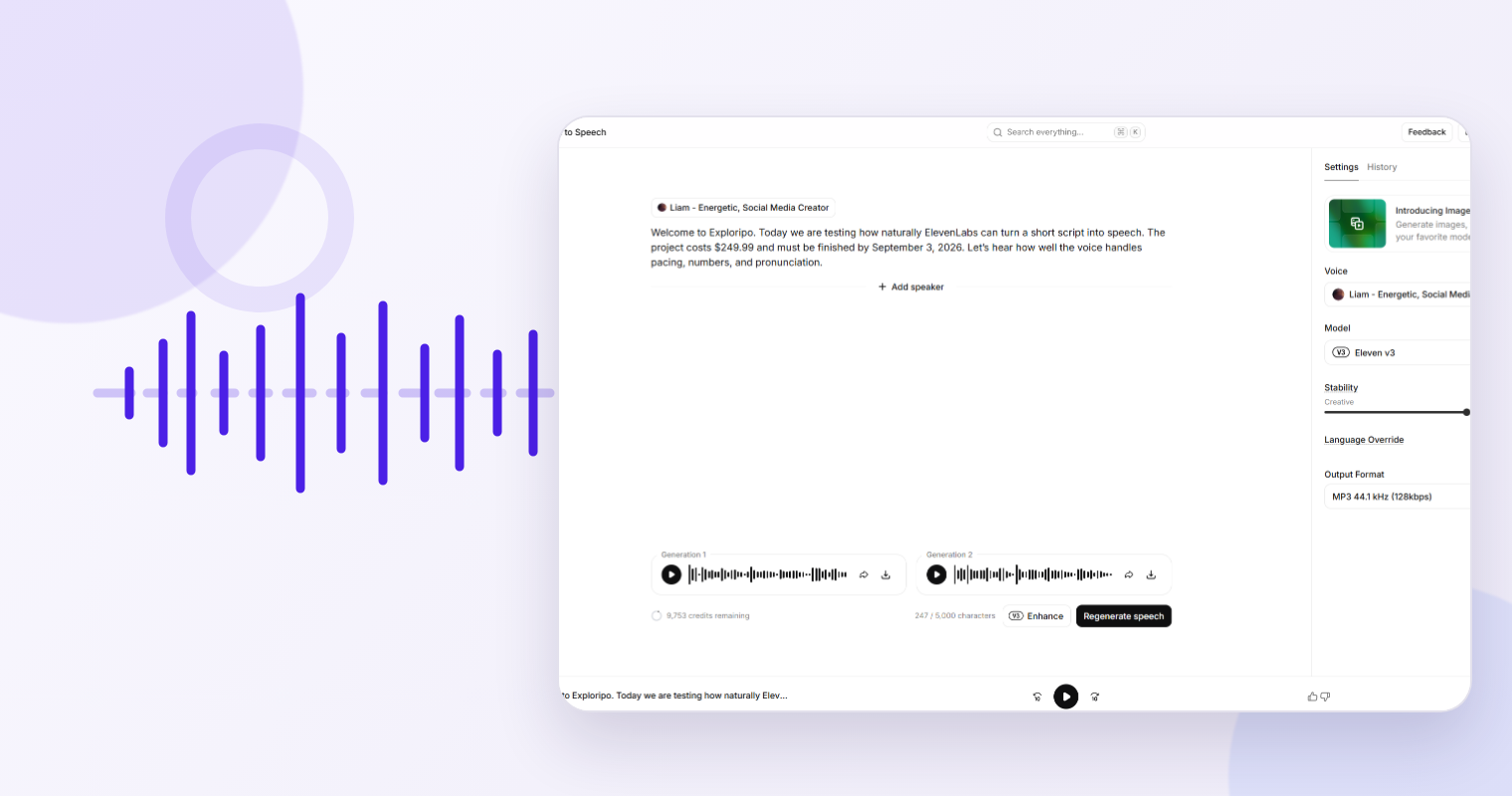
Image context: The ElevenLabs interface above shows the English generation from the same August 2026 Exploripo test session. The Czech result is preserved as audio evidence; this screenshot does not show the Czech output.
A Czech voice can sound convincing in an easy demo and still fail on the line that matters: a surname, a price, a date, or an English product name inside a Czech sentence. A useful ElevenLabs Czech voice test therefore starts with the wording most likely to create publication risk—not with a polished paragraph that gives the model an easy pass.
This guide gives creators, publishers, and localization teams a repeatable pre-publication workflow. It combines one narrowly scoped Exploripo hands-on test with current ElevenLabs documentation and a practical editorial method. It does not claim that one successful clip proves long-form quality or that one voice represents the whole platform.
What Exploripo actually tested
On 23 August 2026, we used an ElevenLabs Free account to generate one short Czech sample with the Liam voice and Eleven v3. We retained the interface’s Generation 1 and used this exact script:
Vítejte na Exploripo. Dnes testujeme, jak přirozeně dokáže ElevenLabs převést krátký český text na mluvené slovo. Projekt stojí 5 490 korun a musí být dokončen 3. září 2026. Řešení je určené českým tvůrcům, kteří chtějí rychle vytvořit srozumitelný hlasový komentář.
In that sample, we found the Czech pronunciation, pacing, sentence prosody, and transitions natural. We did not notice an obvious error in the amount, date, or wording. As an editorial impression—not a blind listening result—the clip could plausibly be mistaken for a human recording on a first listen.
The limits matter just as much as the positive result. We tested one short sample, one voice, and one model. We did not run a blind panel, compare Czech accents, test long-form consistency, or evaluate multiple voices. We also did not test the current Eleven v4 family hands-on. The result supports one narrow conclusion: that specific output was a credible candidate for further editorial review.
For broader buying questions, features, and limitations, read our full ElevenLabs review.
Check the current model before you reuse an old result
Our August test used Eleven v3. ElevenLabs now describes v3 as a previous-generation model and lists Eleven v4 and Eleven v4 Turbo as its flagship speech models. Its current model documentation lists Czech among the supported languages for the v4 family, v3, Multilingual v2, and Flash v2.5.
That does not make an old result invalid, but it prevents a common mistake: presenting a historical v3 observation as evidence of current v4 behavior. Record the model and voice beside every approved asset. If either changes, repeat the test with the real production script.
Build a short, risk-weighted Czech test script
This section is Exploripo’s editorial method. Start with roughly 60 to 120 words that resemble the intended job. Keep the baseline short enough that you can identify why a line failed, but varied enough to expose the likely risks.
Include the following when they occur in the real project:
- Czech names and place names;
- dates, times, quantities, prices, and currencies;
- abbreviations and initialisms;
- English product or company names inside Czech sentences;
- specialist terms from the actual subject area;
- a short sentence, a longer sentence, and a deliberate pause.
A travel narration, software tutorial, medical explainer, and customer notice do not need the same test. Use the vocabulary your audience will hear. A generic demo cannot validate a product name or regulated term that never appears in it.
Generate a baseline and keep the variables visible
Generate a first version with normal spelling and clear punctuation. Record the date, model, voice, relevant settings, exact input, and output filename. These details turn an impression into a reproducible editorial record.
When something is wrong, change one variable at a time. If a name is unclear, test that name before changing the voice and pacing as well. If a pause sounds unnatural, adjust the sentence or punctuation before rewriting unrelated lines. Changing the script, model, voice, and direction together may produce a better clip, but it will not tell you which change fixed the problem.
Listen twice, for two different kinds of error
Have a fluent Czech reviewer make the publication decision. First, ask them to listen without looking at the script. This reveals whether the clip is clear, natural, and appropriate for its audience.
Then listen again while following the source text. On the second pass, check for:
- missing, repeated, or changed words;
- incorrect names, numbers, dates, times, and currency amounts;
- misplaced stress or a pause that changes the meaning;
- awkward handling of English terms in Czech context;
- pacing or tone that conflicts with the content.
“Does it sound human?” is not a sufficient approval question. A clip can sound convincing while saying the wrong number, and it can be intelligible while using the wrong tone for training, legal, or safety-related content.
Correct pronunciation without hiding the test
ElevenLabs’ current text-to-speech best practices say that Eleven v4 accepts IPA enclosed in forward slashes. The company also warns that results can vary by voice and phrase, so important pronunciations should be tested with the selected voice before production.
For repeatable replacements, ElevenLabs provides pronunciation dictionaries. Its documentation describes phoneme and alias rules; for non-English phoneme work, it directs users to Eleven v4. Availability and behavior can depend on the model and workflow, so verify the current documentation for the tool you are using.
Treat these controls as testable interventions, not automatic proof of correctness:
- Save the failed baseline.
- Apply one spelling, alias, or pronunciation change.
- Regenerate the same line with the same voice and model.
- Have the Czech reviewer compare both versions.
- Save the approved rule beside the final script.
Do not silently rewrite a surname or technical term in the final evidence log. The record should show both the published wording and the generation aid used to produce it.
Test numbers and dates as publication-critical content
Numbers deserve their own pass. ElevenLabs notes in its model documentation that Flash v2.5 does not normalize numbers by default in the way users may expect; dates and currencies can also be affected. The company recommends normalizing input before generation for relevant low-latency workflows or using a model and setting appropriate to the use case.
Our v3 Czech sample happened to pronounce 5 490 korun and 3. září 2026 without an obvious error. That is hands-on evidence for those two expressions in that one output—not a guarantee for other amounts, dates, models, or voices. Test every publication-critical number exactly as it will appear in the final script.
Decide whether to revise, escalate, or stop
Use the consequence of an error, not a vague quality score, to make the decision.
| Decision | Use it when | Next action |
|---|---|---|
| Revise | A specific word, pause, or formatting choice is the likely cause | Change one variable and retest the affected line |
| Escalate | The script is legal, medical, safety-related, regulated, or highly visible | Add a qualified Czech editor, subject expert, or voice professional |
| Stop | Core terms remain unclear or the required delivery is still unattainable | Choose another approved voice, rewrite the script, or record a human voiceover |
More regeneration is not automatically progress. If repeated fixes create new problems, a human recording may be faster and safer.
Check publishing rights before the audio goes live
Voice quality and permission to publish are separate checks. ElevenLabs’ current publishing guidance states that its Free plan does not include a commercial license. It says that non-commercial content shared from a Free plan requires ElevenLabs attribution. Paid plans include a commercial license subject to the user’s intellectual-property rights, applicable law, the Terms of Service, the Prohibited Use Policy, and service-specific terms; Beta Services are excluded from commercial use.
Our Czech clip was generated on the Free plan as internal review evidence. We do not treat it as a commercially cleared publication asset. Before publishing your own audio, confirm the plan and service terms that applied when that audio was generated, plus any rights connected with the script and selected voice.
Pre-publication checklist
Before approving a Czech asset, confirm that:
- the saved script exactly matches the intended publication copy;
- the model, voice, settings, generation date, and output file are recorded;
- a fluent Czech reviewer listened once without and once with the script;
- names, numbers, dates, currencies, and specialist terms passed explicitly;
- any pronunciation rule was retested with the final model and voice;
- the delivery fits the audience and content type;
- long-form material was reviewed beyond the opening sample;
- the applicable license, voice rights, and service terms permit the intended use;
- the approved audio and review record are stored together.
A short ElevenLabs Czech voice test is a gate, not a guarantee. Use it to expose the riskiest wording early, preserve the exact settings, and give a Czech-speaking editor a concrete asset to approve. Publish only the output you actually reviewed—not the reputation of the platform, the label on the model, or the promise of a demo.